
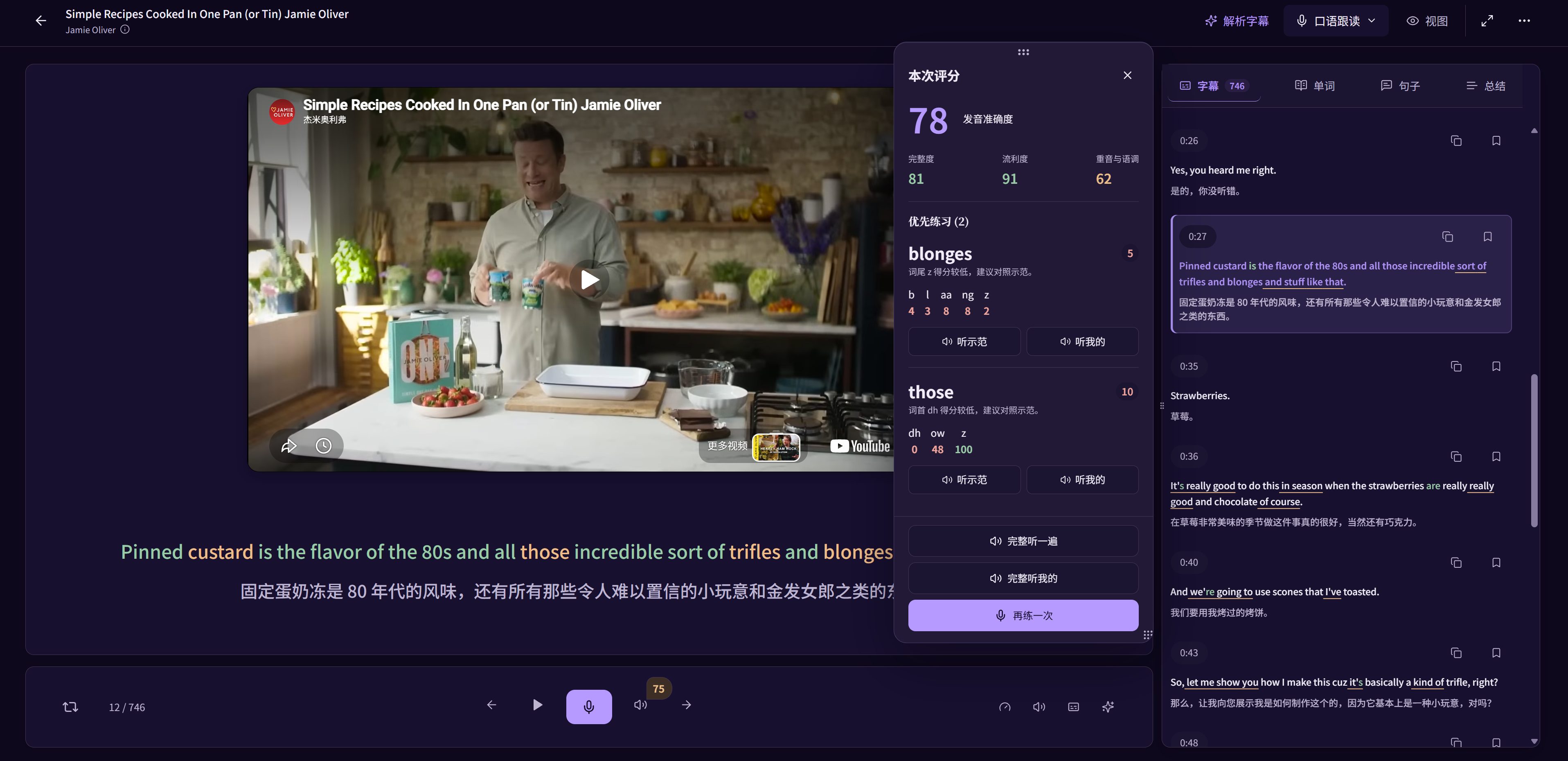
Shadowing and listen-and-repeat are often grouped under speaking practice. The difference matters: speaking while the source continues divides your attention differently from listening to a full sentence, pausing and then recording it.
Neither format needs to be used for every passage. This guide explains how to start with a manageable sentence, compare an attempt and decide when to move between the two.
The difference is when you speak
In continuous shadowing, you speak along with the audio, usually with a small delay, trying to follow the speaker's phrasing and rhythm. You have less time to stop and think about each word.
In listen-and-repeat, you hear a sentence or phrase, pause the recording and then say it yourself. The pause gives you time to recall the meaning, record an attempt and compare a particular part.
- Shadowing: the source keeps playing while you speak.
- Listen-and-repeat: listen, pause, speak, then compare.
- Reading aloud: speaking from visible text without necessarily hearing a source first.
Choose by the task you can actually do
If you lose the sentence's meaning while trying to keep up, begin with listen-and-repeat. If you already understand a short passage and can say its words comfortably, try speaking along to focus on how the phrases move.
For an English sentence such as ‘Could you give me a moment?’, one task might be to hear how the question is grouped. You can first repeat the sentence after a pause, then try following that familiar grouping while the source plays.
Prepare one short sentence
Choose clear audio and a sentence you can understand. Check any unfamiliar phrase before trying to imitate it. Listen for pauses, emphasis and the way neighboring words sound together.
Keep the reference text nearby, but avoid relying only on spelling. The source's sound gives you information that the written sentence cannot show on its own.
Record, compare and change one thing
Listen to the sentence, pause and record an attempt. Play your take and the available source again. Select one audible difference instead of trying to correct everything at once.
You might work on a missing word ending, a pause in the wrong place or a phrase you broke into isolated words. Repeat with that target in mind, then listen to the whole sentence again.
- Understand and listen to the sentence.
- Record a paused repetition.
- Compare one word or phrase with the source.
- Try again, keeping the complete meaning in mind.
Move to continuous shadowing when the passage is familiar
Try following the same short passage while the audio keeps playing. If keeping up forces you to mumble, skip words or forget the message, shorten the passage or return to paused practice.
Speed is not the only goal. You are trying to notice phrasing and reproduce understandable speech. There is no need to imitate every feature of a speaker's accent or treat one recording as a fixed standard.
What a practice tool should help you do
Look for a way to locate a sentence, replay it, record yourself and return to the reference. A transcript can help with meaning, and available pronunciation feedback can help identify a possible target. Automated scores still need to be compared with the audio.
LearnBit combines available sentence audio, recording and supported pronunciation feedback in its practice workflow. It does not turn this website page into a live scoring tool or promise identical phoneme feedback for every language. Use the app's actual language support and current plan access.
Questions about this method
Do I need to keep the audio playing while recording?
Not for listen-and-repeat. Hear a short sentence first, pause, then record your own attempt. Continuous shadowing is a separate timing choice and can be tried after the passage becomes familiar.
Can I start without understanding the words?
For this routine, first choose something you can understand with a little help. Meaning and phrasing give you a clearer practice task than copying a stream of unfamiliar sounds.
Is a higher score the same as better communication?
A score describes an automated assessment of one attempt. It does not fully measure understanding or real conversation. Listen to your take, focus on a particular difference and use the expression in context.