

You play a clip in English with the subtitles off. The words rush past before you can make them out. Turn the subtitles on, and there are hardly any unfamiliar words. You rewind, listen again, and suddenly it all sounds clear. A few days later, you try a different video. The familiar frustration returns.
The difficulty may lie in something easy to overlook: recognizing a word on the page does not guarantee that you will recognize it quickly enough in connected speech. Speakers do not leave a neat gap between every word. Stress, reduced forms, linking, and pauses help organize what they say. As a listener, you have to identify the sounds while keeping up with the meaning.
Shadowing aims to train some of these processes. You listen to a recording and repeat what you hear, staying just behind the speaker. The idea is simple; doing it keeps you busy. Your ears are already taking in the next stretch while your mouth is still working on the last one.
Researchers have studied how shadowing affects listening, pronunciation, and fluency. Keeping up with a recording, becoming easier to understand, and holding a conversation draw on different skills. Understanding those differences helps you choose what to work on. 4 5 6
Know which kind of practice you are doing
If you play a whole sentence, pause, and then say it back, you are doing listen-and-repeat practice. The pause gives you time to hold on to the words, prepare your pronunciation, and recall what the sentence means.
Reading a transcript aloud in time with a recording is another common exercise. The text can help you keep your place, though it may also shift your attention toward reading the words in front of you.
In typical shadowing, you follow speech as it unfolds. The recording keeps going, and so do you, with a short delay between the two. There is no need to force that delay into an exact number of seconds. What matters is that listening and speaking overlap, rather than waiting for each complete sentence before you begin. 2
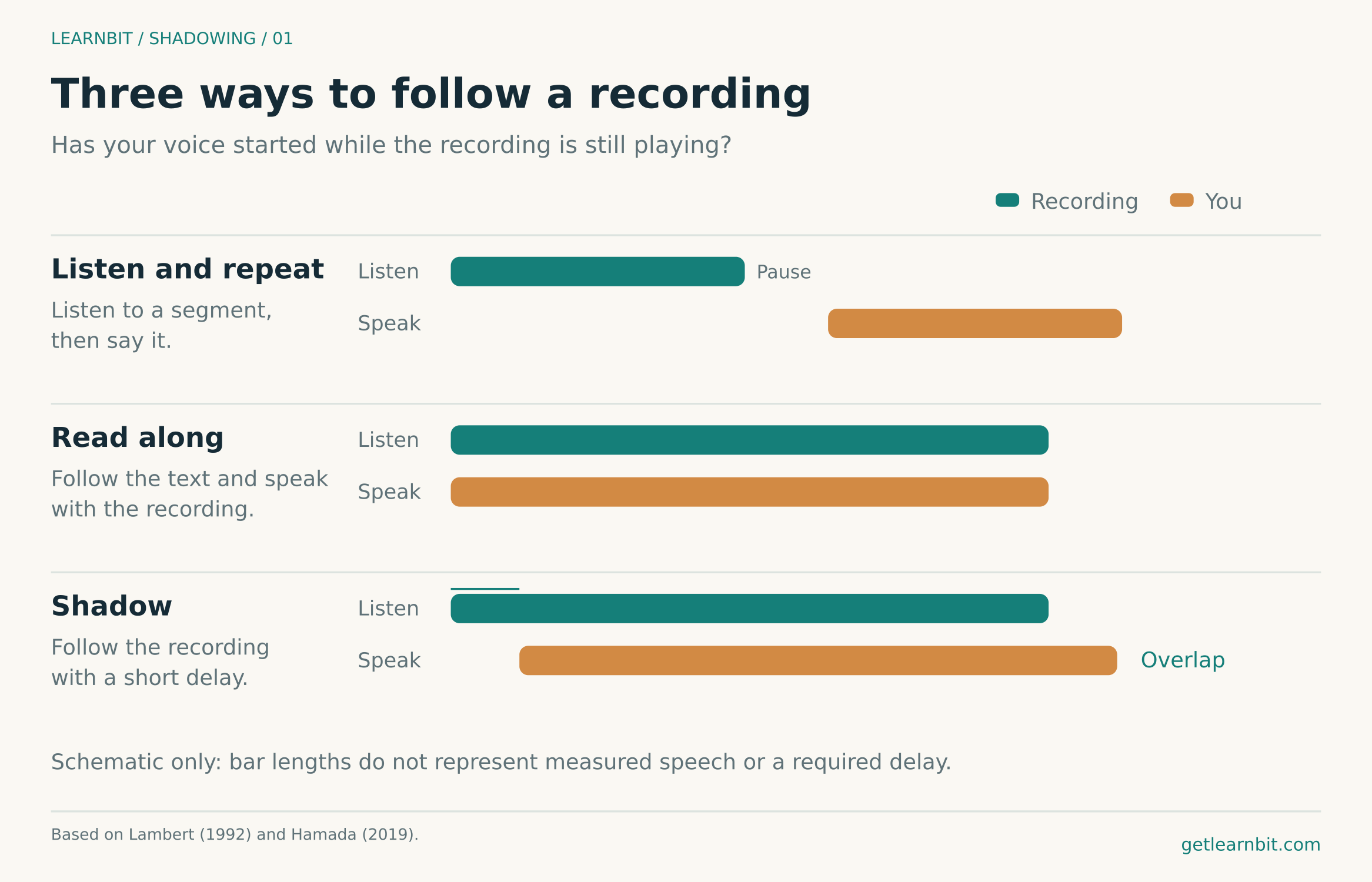
In strict shadowing without a transcript, sound is your main guide. Teaching practice also includes versions that use a text or place more emphasis on prosody or comprehension. Hamada and Suzuki situate a range of techniques within a framework for deliberate practice, distinguishing work on speech processing from work on meaning. 8
These distinctions help you understand what you are practicing. Reading first, pausing, and repeating are all reasonable ways to begin. When you want to check how well you can follow by ear, try putting the text aside.
If you already enjoy English-language videos or podcasts, you have a place to start. LearnBit brings subtitle word lookup, sentence replay, dictation, and recorded speaking practice together. Work out what a sentence means, listen closely, say it yourself, and save the expressions you want to remember.
The examples here use English, but LearnBit supports learning in 10 languages: English, Chinese, Japanese, Korean, French, German, Spanish, Italian, Brazilian Portuguese, and Russian. Choose your native language and the language you want to learn, then explore videos, podcasts, and reading material that interest you.
From attention experiments to language classrooms
Imagine two people speaking at once in the same room. You want to listen to one, but the other voice keeps intruding. How could you show that you are actually following the speaker you chose? One straightforward way is to repeat what you hear as you hear it.
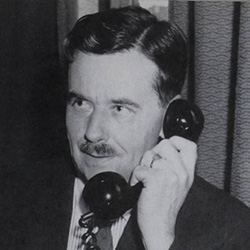
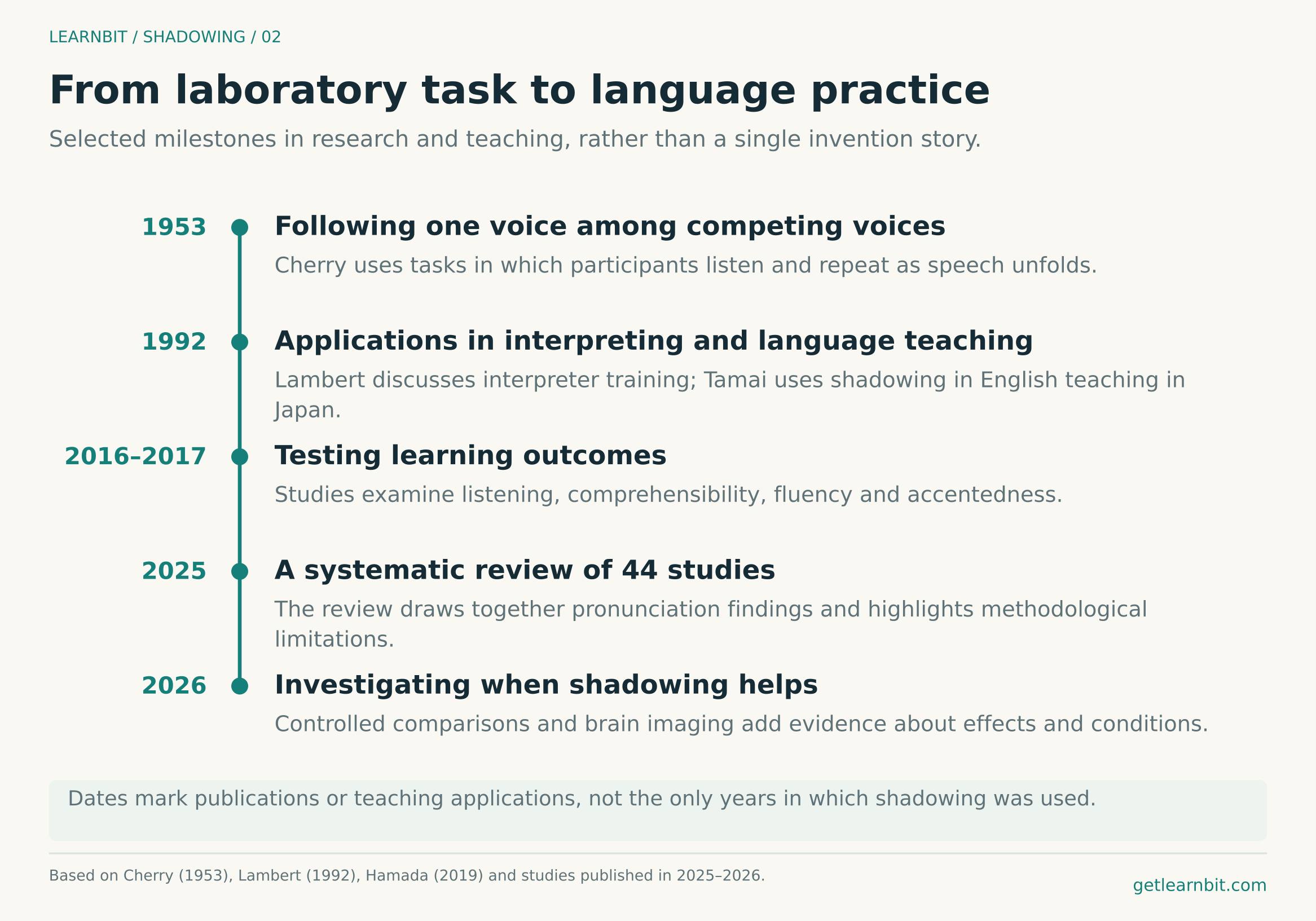
In 1953, E. Colin Cherry reported a series of experiments on speech recognition. Some presented different messages to the two ears and asked participants to repeat one message while listening. People could follow the message they attended to, yet often could not report what the other message had said. These experiments became classics in the study of selective auditory attention. 1
The experimental roots of shadowing are commonly traced to this work. Cherry was studying auditory attention: how people select information from competing streams of sound. The task later found a place in language teaching.
Shadowing later became part of interpreter training. Practicing simultaneous listening and speaking within one language introduces learners to this kind of dual task. Simultaneous interpreting is much more demanding because it also requires moving between languages. Lambert's 1992 paper, Shadowing, discusses the exercise and its cognitive background. 2
The task also found its way into foreign-language classrooms. Hamada's review identifies Tamai's use of shadowing in English listening instruction in Japan in 1992 as an important milestone. Gradually, an experimental task and preparatory exercise for interpreters became a method available to ordinary language learners. 3
What happens when you listen and speak at once
When you listen to a story, you can miss a few words and use the context to fill in the gaps. Shadowing makes the task more exacting. If you fail to identify a sound in time, you may skip it, stop, or substitute something that sounds roughly similar. Gaps that might hide behind “I more or less understood it” become easier to notice.
This helps explain why shadowing is often used to train bottom-up listening processes: identifying words from the sounds and building toward the meaning of a sentence. The complementary process, top-down processing, draws on the topic, context, and what you already know. Real-world listening brings both together. 3
You also have to hold the sounds in mind briefly. Think of a small workbench that quickly fills up: before you finish saying one stretch of speech, the next has arrived. This short-term storage and rehearsal of speech are often discussed in terms of the phonological loop, a component of working memory. 9
The workbench image also captures a familiar experience: your mouth keeps moving, but you lose the meaning. For a learner who is not yet proficient, identifying and producing the sounds may already consume much of the available attention. Understanding the sentence can fall behind. Successfully imitating speech does not guarantee that you have understood it. 3
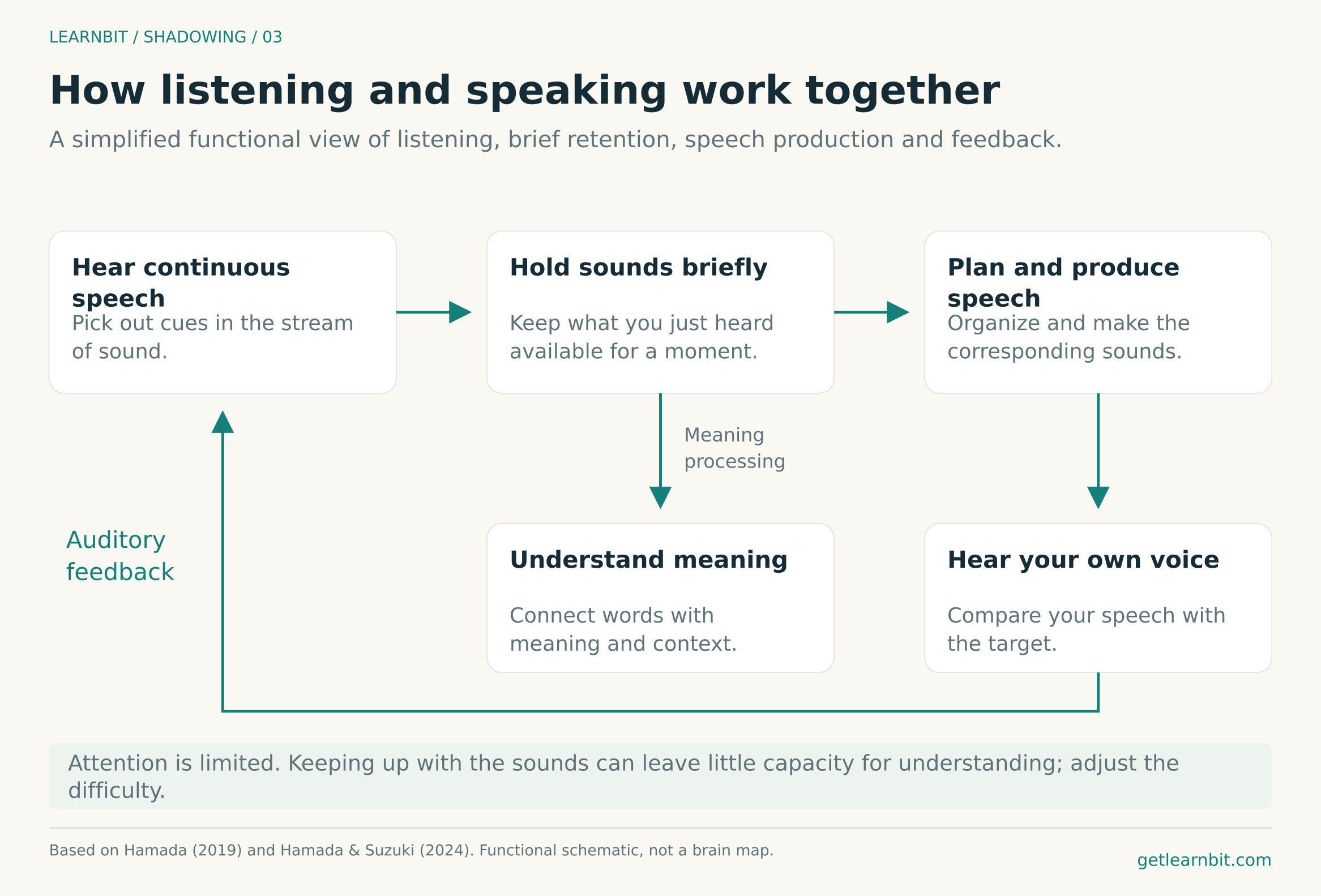
This is where automatization comes in: as recognizing sounds and coordinating speech become more familiar, learners may have more attention available for understanding the message. 8
“Building muscle memory in your mouth” is a useful everyday metaphor, but it captures only part of the task. Speaking another language requires coordinating movements, managing their timing, and using what you hear as feedback. Practice needs to address that coordination. A tired mouth, by itself, is no measure of a good session.
What studies mean by improvement
Three measures are often confused. Intelligibility concerns how much a listener actually understands. Comprehensibility concerns how easy or difficult speech is to understand. Accentedness concerns how different the pronunciation sounds from a reference accent. Someone can speak with a noticeable accent and still be clear and effortless to understand. 5
Hamada's 2016 study involved 43 Japanese university students learning English over nine lessons. Listening questions and dictation gap-fill tasks were used to compare learners at different starting levels. Both proficiency groups improved on measures of speech perception, but improvement on the high-school-level listening questions appeared only in the lower-proficiency group. 4
The study compared two groups with different starting levels. Its findings suggest that both proficiency and the type of listening task matter when assessing progress.
In a 2017 study, Foote and McDonough asked learners to practice short dialogues on mobile devices and record their shadowing. Sixteen participants completed the eight-week study, which required at least four sessions a week of at least ten minutes each. English-speaking listeners rated the test recordings. Imitation performance, fluency, and comprehensibility improved; accentedness did not change significantly. 5
Smoother speech and greater ease of understanding were encouraging findings. Without a control group, the contribution of other English learning during the study could not be separated out.
Taking a broader view, Whitworth and Rose's 2025 systematic review included 44 studies. Overall, the literature offered promising evidence for comprehensibility, intelligibility, and some aspects of fluency and prosody. Findings on the production of individual speech sounds were mixed. Many studies relied on controlled tasks, leaving room for better assessment of lasting gains, spontaneous speech, and outcomes evaluated by actual listeners. 6
The review used a narrative synthesis to examine findings and differences across the studies.
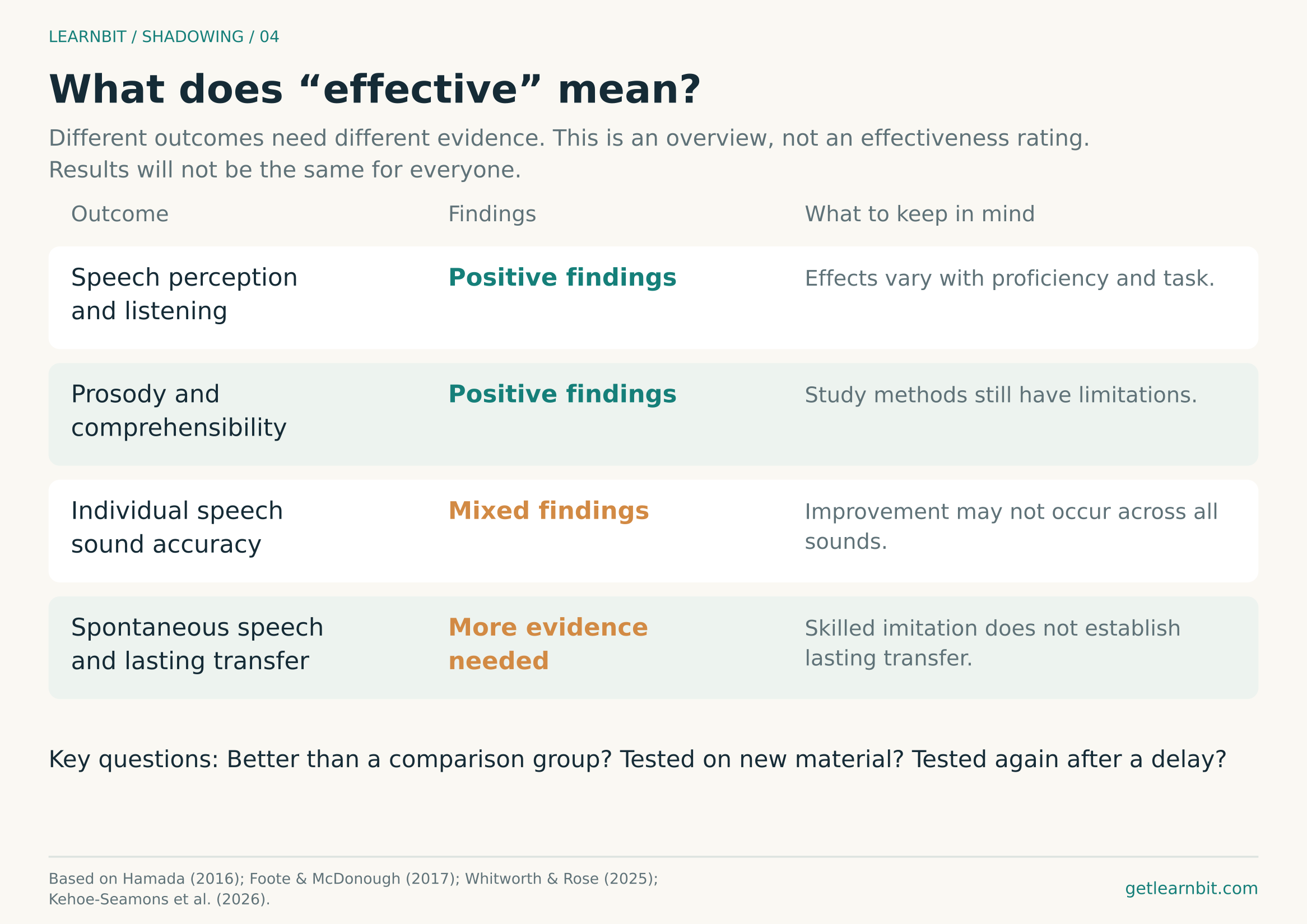
Another study is worth reading alongside these findings. In 2026, Kehoe-Seamons and colleagues examined ten weeks of shadowing with a transcript among intermediate adult learners in a university intensive English program. Both groups made some progress, but no significant between-group differences were found in fluency, comprehensibility, accentedness, or imitation quality. 7
Both groups took part in the course, and text shadowing showed no additional advantage. Comparing practice methods means looking at differences between groups as well as changes over time.
When you read that a method is “scientifically proven to work,” ask two questions: What was measured? Compared with what? Those questions will often tell you more about how to practice than a paper's title will.
What brain imaging can tell us
Some researchers have taken shadowing into the brain-imaging laboratory.
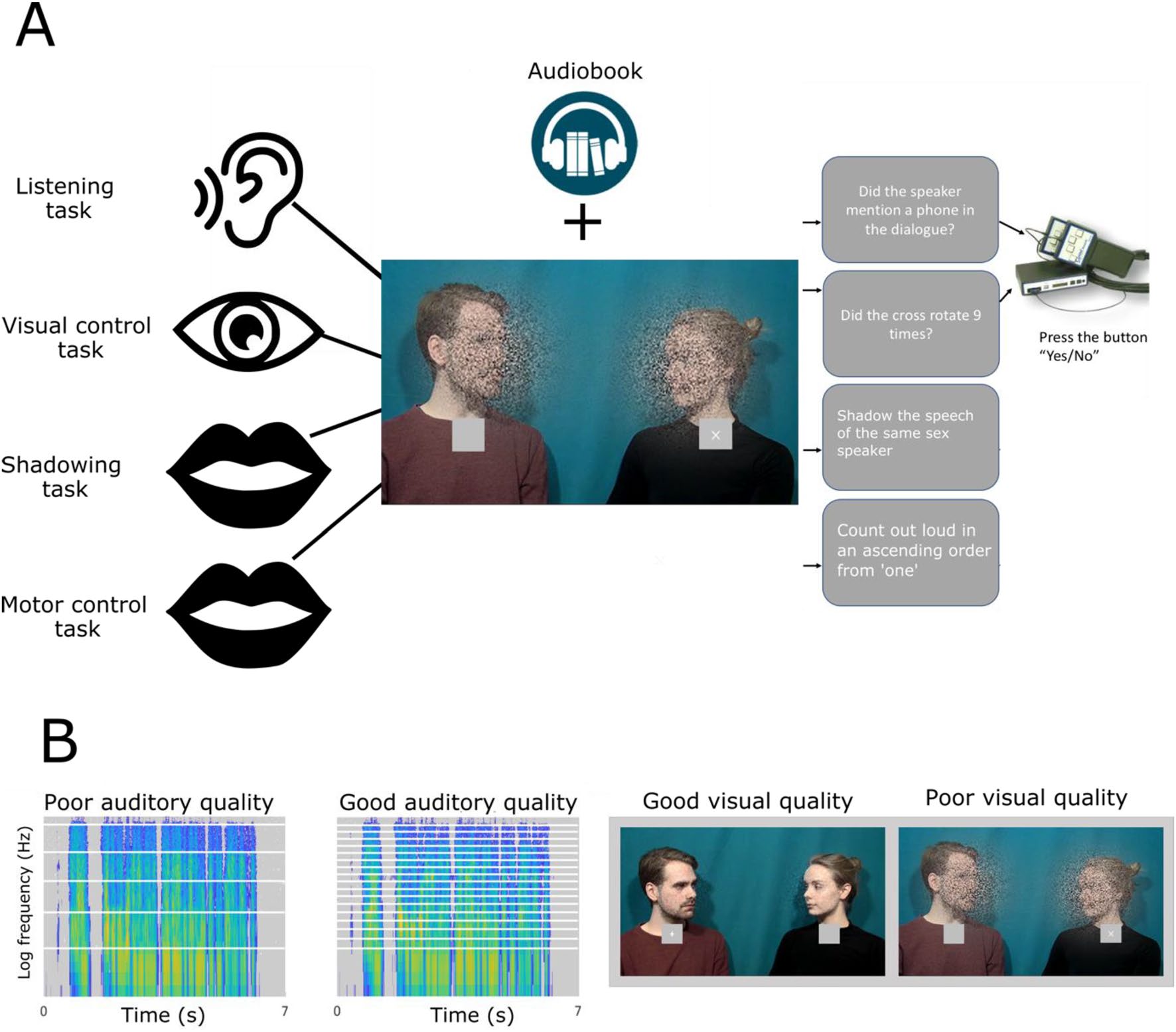
In 2022, Wikman and colleagues compared attentive listening with shadowing in the presence of distracting speech. The tasks recruited overlapping perceptual and frontal networks, with some differences in task-related activity. The analysis of 17 native Finnish speakers explored how hearing and articulation work together during simultaneous listening and speaking. 11
Takeuchi and colleagues' four-week training study compared shadowing, reading aloud, and language training without speaking. When the shadowing and reading-aloud groups were pooled, they responded faster on a working-memory task than the two non-speaking groups. The researchers also observed changes in specific measures of brain structure and activity. The findings concern those working-memory tasks and imaging measures. 9
A question closer to everyday video learning is whether seeing a speaker's face helps you shadow their speech.
In a study published in 2026, Jeong and colleagues asked 42 Japanese learners of English to complete four conditions: listening or shadowing, with either a visible face or a pixelated image. When the face was visible, participants reproduced content words more accurately during shadowing, and differences in brain activity were also observed. 10
The experiment suggests that the face and mouth offer useful cues during shadowing. Longer-term effects on speaking still need further study.
Brain research is most useful here when it helps us ask more precise questions. What changes when the task changes? How do participants use the available cues? Learning gains still have to be assessed through what people can actually do.
Follow how the voice carries meaning
Many learners focus on whether they have missed a word. Once they can keep up with every word, they try to go faster. It is easy to overlook more revealing details: what the speaker emphasizes, what they glide over, and where they pause.
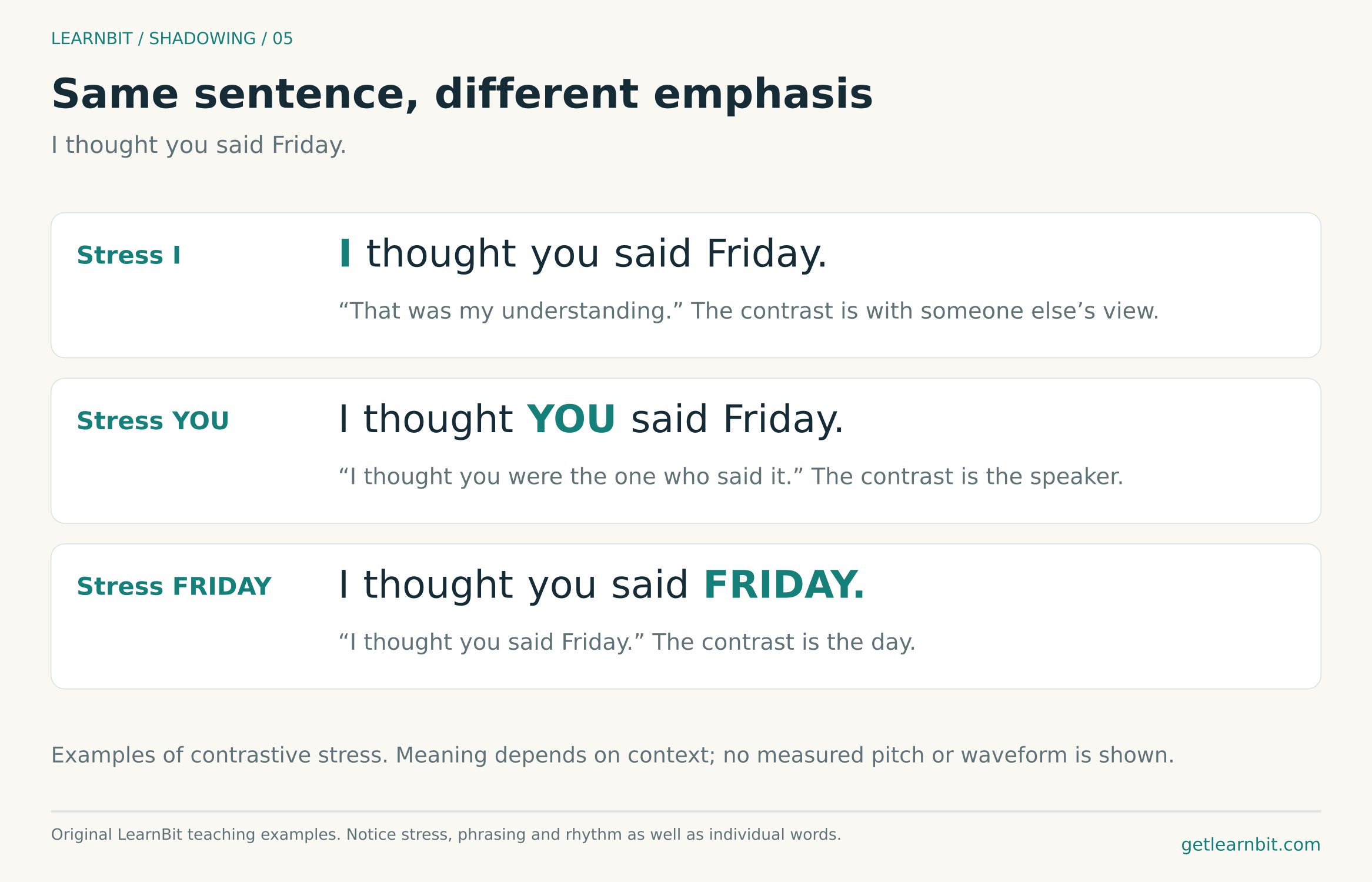
Take a simple sentence:
I thought you said Friday.
Stress YOU, and the contrast is often between you and someone else. Stress FRIDAY, and the contrast is often between Friday and another day. The precise meaning still depends on context, but the focus of the message has shifted.
Choose one target for a session. Today, pay attention to pauses between thought groups. Next time, listen for a few reduced words you tend to miss. After that, compare your sentence stress with the recording. You will then know what to listen for when you play yourself back.
If you repeatedly struggle to distinguish a particular sound, shadowing the whole passage ten more times may not solve the problem. Isolate the sound first, learn to hear the distinction and understand how to produce it, then put it back into the sentence. Shadowing can bring the parts together; specific difficulties still need focused practice.
A practice session you can actually finish
Start with a short passage you are willing to hear several times: an answer from an interview, a clearly delivered explanation, or a few sentences from a podcast. Choose something whose main meaning you can understand after reading the transcript, with clear audio and a manageable length that leaves you room to notice details.
To learn English with YouTube, use LearnBit's video learning tools to find a clip you want to understand. Follow the subtitles to a sentence, replay it, and adjust the speed. Look up unfamiliar words in context or use sentence analysis to work through a longer sentence. Prefer audio? Podcast learning lets you work with an episode and its transcript in the same way. Pick a short section to study closely, then keep watching or listening.
The following sequence combines recognizing sounds, understanding meaning, and focused practice. Adjust it to the difficulty of your material. 8
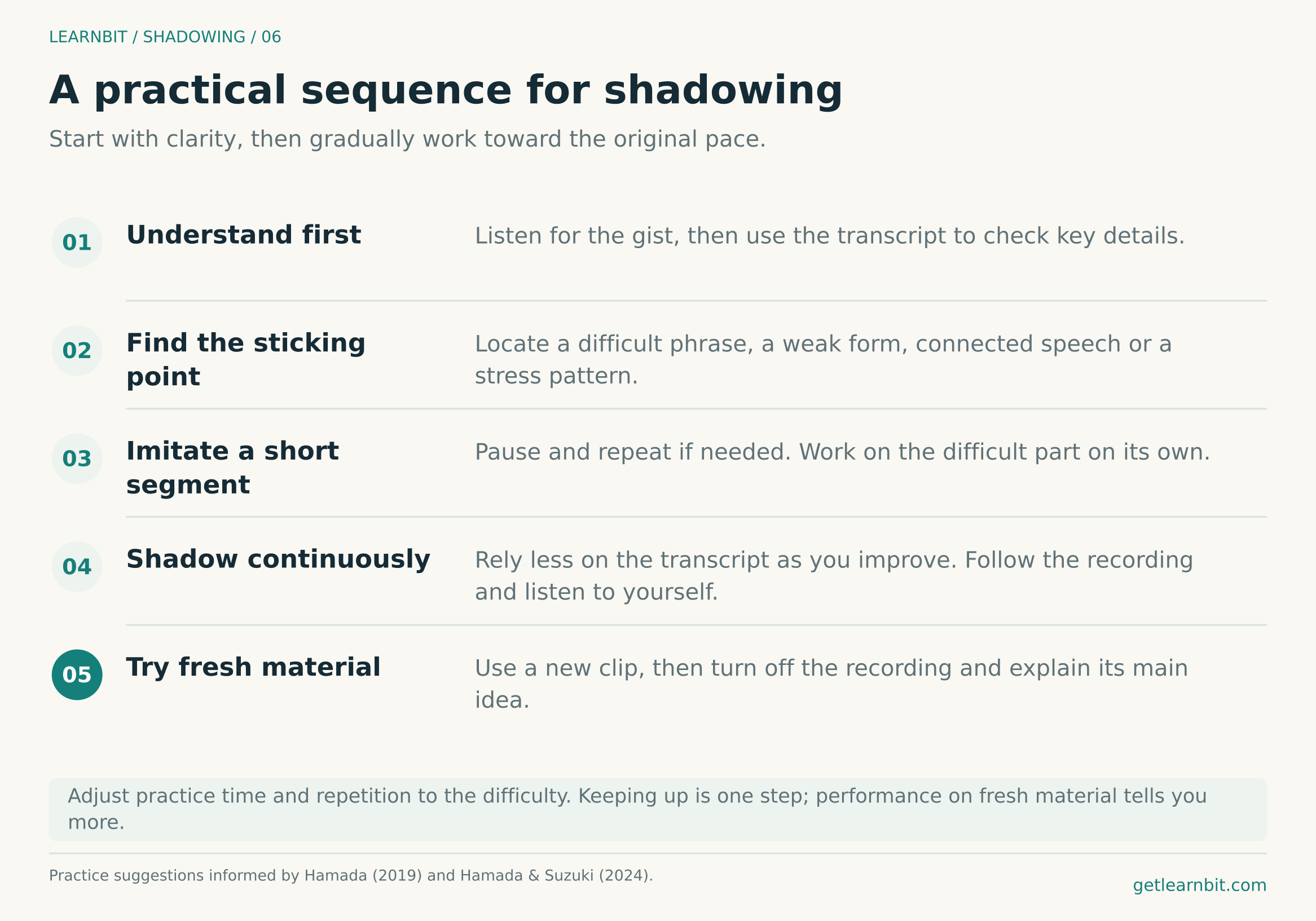
Listen once, then check the meaning. Stay silent at first and see what you understand. If you get stuck, use the transcript to clear things up. If unfamiliar words crowd the passage and the sentences still make little sense, choose something easier. Chasing a string of unfamiliar sounds makes it hard to tell what is going wrong.
Pinpoint the difficulty. Instead of starting the whole passage again, find one specific spot: a reduced word, a stretch of linked speech, or a pause where you keep losing your place. Work out whether you did not recognize the sound, knew how to say it but could not do so in time, or did not understand the meaning. Each problem needs a different response.
Allow yourself to pause and imitate. Listen to a short section containing the difficult part, stop, and say it back. Use the transcript or slow the recording a little if needed. This gives you time to connect sound and meaning before attempting continuous shadowing.
Then try continuous shadowing. Return to the short passage and follow with a slight delay while the recording keeps playing. Once it becomes familiar, try without the transcript. If you miss a word, rejoin at the next thought group and check the gap afterward. Trying to recover one word can otherwise cost you the rest of the passage.
Make a recording, then turn off the original. When you listen back, compare one target first: whether a particular stress is clear, for example, or whether you have broken the sentence into too many pieces. Then explain the content in your own words. If you can imitate the speaker but cannot say what the passage is about, spend more time on comprehension and retelling.
Try starting with around ten minutes, split between understanding the passage, working on difficult parts, shadowing, and listening back. Adjust the session to the material and your energy. Foote and McDonough also used sessions of at least ten minutes in their study. 5
When you're ready to record, use LearnBit's speaking practice to focus on one sentence. Listen to the original or a model recording, record yourself, then compare the two for missing words or unclear sounds. Word- and phoneme-level pronunciation feedback helps you choose what to work on, and you can revisit the sentences you've practiced. Pick one detail and record again. Use these paused recording sessions to work through difficult parts, then return to continuous shadowing with the original audio. 12
Use the feedback to choose your next step: find one spot to improve, listen again, say it again, and compare your recordings. Each attempt gives you something specific to work on.
Check your progress with something new
It is normal to sound smoother on your tenth attempt at the same recording than on your first. You may have become more familiar with the sounds, or you may have memorized what comes next. To help distinguish these changes, keep three small checks in your routine.
| Check | What to do | What to look for |
|---|---|---|
| Familiar material | Return to a practiced passage the next day and listen and shadow again | How much of the practiced material you retain and whether the original difficulties remain |
| New material | Try another short passage from the same speaker or at a similar difficulty, without reading first | Whether recognizing speech feels easier and you rely less on familiar content |
| Independent speech | Turn off the audio and retell the content in a few sentences, or answer a related question | Whether you can choose your own words, organize the information, and turn understanding into speech |
Use these three checks to follow your progress from familiar material to speaking in your own words. Note specific changes: a word you recognized without the transcript, a sentence with two fewer hesitations, or an idea you could explain yourself.
The words you meet while shadowing are worth coming back to. In LearnBit, you can save words, phrases, and sentences with their source and your own notes. FSRS schedules vocabulary reviews based on your learning history. When you finally catch a phrase you've been missing, save it with its sentence. During review, return to the original text or playback position to hear how it was used. Your vocabulary practice then builds on the listening and speaking you've already done.
What if I keep falling behind? Shorten the passage, listen and repeat first, and make sure you understand it before returning to continuous shadowing. A recording that is a little fast can be a useful challenge. If all you can produce is a scattering of sounds, the task probably needs adjusting.
Do I have to avoid subtitles throughout? Subtitles are useful. Use them to check the content during preparation, then set them aside when testing how well you can follow by ear. What matters is knowing which cues you are relying on at that moment, rather than keeping the same setting throughout every stage.
Do I have to copy the accent exactly? You can choose a particular speaker as a clear model without making the elimination of every trace of accent your goal. Whether people understand your pronunciation, how much effort communication takes, and whether your tone conveys the intended meaning are more concrete things to observe.
Can shadowing replace conversation? Shadowing supplies the words for you. Conversation also requires deciding what to say, responding to someone else, and rephrasing when a misunderstanding arises. Retelling a passage, asking a question, or having a short conversation after practice gives those skills some attention too.
Shadowing turns frustrations such as ‘I can't follow what people say’ or ‘I keep hesitating’ into smaller problems you can work on. Today, you notice a word you used to miss. Tomorrow, you place the stress more clearly in a sentence. A few days later, you try a passage you haven't practiced. Those changes give you something concrete to track and a clear place to start next time.
Start with one sentence today. Open LearnBit and choose an English-language video or podcast you'd like to understand. Listen closely to one sentence, record yourself saying it, and save an expression you want to use. Pick up from there next time.
References and further reading
Years below follow the journal volume and issue where available; online-only publications are noted separately. The numbered links in the text lead to the original papers or publishers' pages.
Cherry, E. C. (1953). Some Experiments on the Recognition of Speech, with One and with Two Ears. The Journal of the Acoustical Society of America, 25(5), 975–979. DOI: 10.1121/1.1907229. Early experiments on speech recognition and selective attention.
Lambert, S. (1992). Shadowing. Meta, 37(2), 263–273. DOI: 10.7202/003378ar. Shadowing in interpreter training and its theoretical background.
Hamada, Y. (2019). Shadowing: What is It? How to Use It. Where Will It Go? RELC Journal, 50(3), 386–393. DOI: 10.1177/0033688218771380. A review and discussion of teaching practice; first published online in 2018. The account of Tamai's early classroom application is drawn from this review.
Hamada, Y. (2016). Shadowing: Who benefits and how? Uncovering a booming EFL teaching technique for listening comprehension. Language Teaching Research, 20(1), 35–52. DOI: 10.1177/1362168815597504. A study of 43 Japanese university learners of English; first published online in 2015.
Foote, J. A., & McDonough, K. (2017). Using shadowing with mobile technology to improve L2 pronunciation. Journal of Second Language Pronunciation, 3(1), 34–56. DOI: 10.1075/jslp.3.1.02foo. An eight-week study with 16 completers and no control group.
Whitworth, B., & Rose, H. (2025). A Systematic Review of Research on the use of Shadowing for Second Language Pronunciation Teaching. Research Synthesis in Applied Linguistics, 1(2), 239–269. DOI: 10.1080/29984475.2025.2546827. A systematic review of 44 studies using narrative synthesis.
Kehoe-Seamons, M., Tanner, M., Hartshorn, K. J., & Martinsen, R. (2026). The Effect of Text Shadowing on English Language Learners’ Pronunciation Development: A Quasi-Experimental Study. Language Teaching Research, OnlineFirst, July 18. DOI: 10.1177/13621688261462581. A ten-week quasi-experimental study of shadowing with a transcript.
Hamada, Y., & Suzuki, Y. (2024). Situating Shadowing in the Framework of Deliberate Practice: A Guide to Using 16 Techniques. RELC Journal, 55(1), 219–227. DOI: 10.1177/00336882221087508. A framework for teaching and types of practice; first published online in 2022.
Takeuchi, H., et al. (2021). Effects of training of shadowing and reading aloud of second language on working memory and neural systems. Brain Imaging and Behavior, 15, 1253–1269. DOI: 10.1007/s11682-020-00324-4. A four-week training study; first published online in 2020.
Jeong, H., Kadota, S., Kajiura, M., Nakanishi, H., Kazai, K., Kawasaki, M., Nakano, Y., & Hase, N. (2026). Seeing the Speaker’s Face Enhances Second Language Shadowing: Neural and Behavioral Evidence. Language Learning. DOI: 10.1111/lang.70026. A study of visible facial information, immediate shadowing performance, and brain activity.
Wikman, P., Ylinen, A., Leminen, M., & Alho, K. (2022). Brain activity during shadowing of audiovisual cocktail party speech, contributions of auditory-motor integration and selective attention. Scientific Reports, 12, 18789. DOI: 10.1038/s41598-022-22041-2. A brain-imaging experiment comparing listening and shadowing under distracting conditions. Figure 1 is reproduced in this article, © The Author(s) 2022, CC BY 4.0.
LearnBit. Product features: YouTube learning, podcast learning, speaking practice and pronunciation feedback, and vocabulary collection and review. Accessed November 3, 2026.