
You save an unfamiliar word from an English video, then another, then a few more. By the end, your vocabulary list has grown by dozens of entries. It feels like a good study session.
A few days later, you open the list. You cannot remember where some words came from, and even their definitions look unfamiliar. Reviewing the whole collection feels exhausting.
Saving a word means spending more time on it later. Before you add the next one, ask: Why is this word worth learning?

You can look up a word without saving it
On the Anki forum, a learner with around 5,000 words was still working out how to balance new cards with reviews. They found it easy to add too much because the extra workload did not appear immediately.1
In another discussion, someone described reordering new cards by word frequency to study common words first.2
There is more to learn than you have time to study each day. Looking up a word helps you follow the video now. Saving it gives you something to review later. A word can be worth checking without needing a place in your list.
Which words deserve your attention first?
Start with common words you do not know well. You are likely to meet them in different videos, articles, and conversations, giving you chances to use what you learn. Vocabulary researcher Paul Nation uses frequency and range of occurrence to guide learning priorities, while distinguishing general from specialized vocabulary.3
Consider what you need soon. If you watch technical talks, work-related expressions may deserve early attention. If you are planning a trip, vocabulary for transport, accommodation, and ordering food has an obvious use.
A phrase that makes you think, "That's what I've been trying to say about my work experience," is also worth saving. You already have a situation in mind for using it.
You may know the individual words but not how to use them together. Save useful combinations, phrases, and unfamiliar meanings of known words too. Those gaps matter as much as new vocabulary.
Use three columns to narrow the list
A word can look impressive without being useful to you. A few reference points can help you choose where to spend your time.
In LearnBit, you can browse the current video's word list and sort by occurrence count, frequency rank, or recognition percentage.
| Indicator | What it tells you | How to use it |
|---|---|---|
| Occurrence count | How often the word appears in this video | Find recurring words, then check how they are used in the original sentences |
| Frequency rank | How common the word is in the source vocabulary dataset; a smaller number means a higher rank | Find common words you do not know well yet |
| Recognition percentage | A word-level recognition reference from the source dataset | Consider it alongside meaning and likely use when choosing priorities |
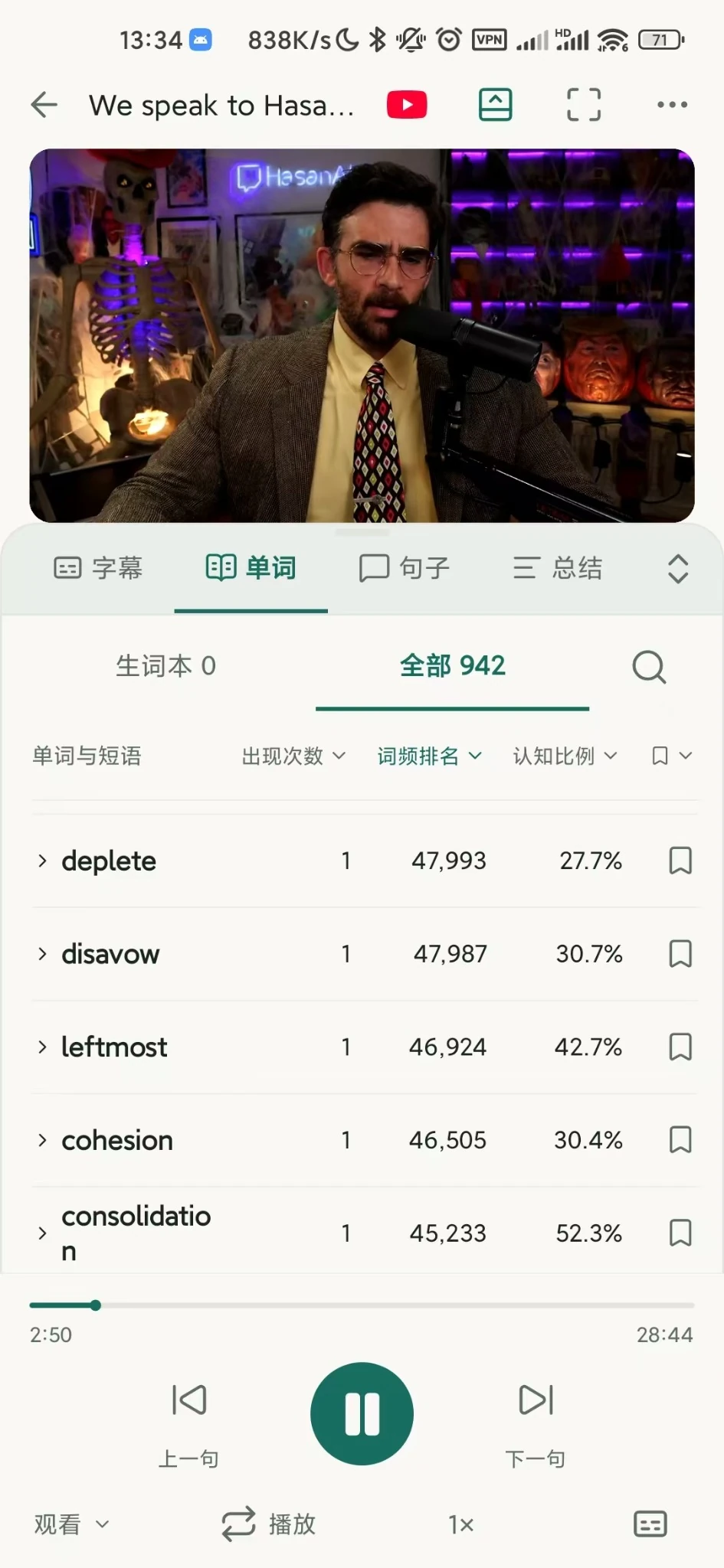
A technical term repeated throughout an interview may be essential to following that video but uncommon in everyday conversation. Keep its count in the video separate from its general frequency.
Frequency also differs from how widely a word is known. Brysbaert and colleagues studied more than 60,000 English words, using word prevalence for the proportion of participants who reported knowing a word. It provided information beyond frequency.4
LearnBit's recognition percentage comes from its vocabulary dataset. It describes the word, while your own recall and use tell you how well you know it.

Sort by frequency when you want to fill gaps in everyday vocabulary. If a video is hard to follow, check which words keep appearing. For each candidate, consider whether you expect to return to the topic or want to use the expression yourself.
One sentence can offer different words to save
The subtitles below contain milkweed, a plant name, and give back, which here means contributing or helping in return.

If your goal is everyday conversation, give back is worth noticing. You could use it to talk about contributing to a community or helping others. Both words are short and may be familiar, but using them together still takes practice.
For milkweed, finding out that it names a plant may be enough to keep watching. If you rarely spend time on this subject, you can leave it there for now.
Someone interested in gardening, ecology, or butterfly conservation might choose differently. Milkweed could appear again in the videos and articles they want to explore, giving them a clear reason to learn it.
Your interests, work, and communication needs affect the choice. The same word can be a priority for one person and something to pass over for another.

Choose a word in LearnBit, then check its sentence
It helps to have the original sentence and audio nearby when deciding what to save. LearnBit keeps the word list, examples, and video playback in one learning view, so you can check a use without searching elsewhere or repeatedly moving the playhead.
The examples here use English, but LearnBit supports learning in 10 languages: English, Chinese, Japanese, Korean, French, German, Spanish, Italian, Brazilian Portuguese, and Russian. Choose your native language and the language you want to learn, then collect vocabulary from YouTube videos, podcasts, or reading material that interests you.
Sort the list for what you need, or search for a word you just missed. Expand it to see its original sentence and translation. If it appears in several places, switch between the examples to compare how it is used.
For an unfamiliar word, start with a short definition, then open AI word lookup to understand its meaning in the sentence. If the words are familiar but the sentence is difficult, AI sentence analysis explains its structure and key phrases. You can then decide what you want to learn from it.
Jump from an example to its point in the video and hear how the speaker uses the expression. With give back, for instance, listen again after checking the meaning, then think of a situation where you would say it.
Save it when you decide to learn it. LearnBit keeps the original sentence, translation, source, and timestamp with the word, so you can return to where you first encountered it during review.
Practice saved words with dictation and shadowing
After choosing a word, hide the explanation and try to recall its meaning in the sentence. Listen again to check. If you want to use it in conversation, try it in a situation from your own life.
In a vocabulary-pair learning experiment, Karpicke and Roediger found that continued retrieval practice after a first successful recall improved recall one week later.5 Give yourself another chance to bring the meaning to mind after you have understood it.
In LearnBit, you can practice the sentence through dictation or record yourself saying it. Once it feels familiar, try some English shadowing practice: keep the original recording playing and repeat what you hear with a short delay, following the connected speech, stress, and pauses. The word you saved becomes part of a sentence you practice saying aloud.
Saved words enter vocabulary learning and review, with FSRS scheduling later reviews based on your learning history. When the word comes up again, try recalling its original sentence and saying it smoothly.
If reviews already fill today's study time, pause before adding more. You can also revisit earlier saves and set aside words you have little use for right now.
Next time you open LearnBit, choose a few words whose purpose you can explain. "I want to use this when I talk about my work" is a good start. Add that reason to your notes so you know why you saved the expression when it comes up for review.
References
Anki Forums. How many new cards can be studied every day, while the workload stays the same long term?, March 2026. A learner discussion about adding cards and managing review workload.
Anki Forums. Question About Handling New Cards, May 2024. Includes a learner's account of arranging new cards by word frequency.
Nation, I. S. P. (2022). The goals of vocabulary learning. In Learning Vocabulary in Another Language, 3rd ed. Cambridge University Press.
Brysbaert, M., Mandera, P., McCormick, S. F., & Keuleers, E. (2019). Word prevalence norms for 62,000 English lemmas. Behavior Research Methods, 51, 467–479.
Karpicke, J. D., & Roediger, H. L. III. (2008). The Critical Importance of Retrieval for Learning. Science, 319, 966–968.