
You try a cartoon because you have heard it is good for learning English. The story is simple, but the characters speak quickly and you miss the jokes. Then you switch to a cooking, photography, or programming tutorial on a familiar subject and find you can follow much more.
Or you have saved dozens of English channels, only to find that watching them means pausing, looking up words, and rewinding every minute. The videos are good. Studying with them is exhausting.
When choosing a video, start with a question more useful than how advanced it looks: Can I follow what it is telling me, and do I want to know more?

Comprehensible input means following the message
Comprehensible input is language you can understand with help from context, images, and what you already know.
Imagine someone in a video picking up an umbrella, saying something, and stepping outside into the rain. Even if one word is unfamiliar, the action and setting may help you understand. A sentence of the same length could be much harder to follow when two strangers are discussing a controversy you know nothing about.
Krashen's Input Hypothesis is often summarized as "i+1": understanding language a little beyond your current ability. The "+1" has no precise scale, and it does not mean every sentence should contain one new word. His account emphasizes how context and knowledge of the world support understanding, without requiring each piece of material to target an exact difficulty level.[2]
When trying a video, see whether you can follow what is happening and use the clues to understand some new expressions.
Vocabulary coverage counts word occurrences: a word that appears several times is counted each time. Knowing 95% of the words in that sense is different from understanding 95% of the message or learning 95% of its expressions.
In a listening study using spoken narratives, non-native listeners varied considerably in comprehension at 90% vocabulary coverage. Their performance was more consistent at 95%. These figures help explain the effort unfamiliar words demand. Videos also offer visual clues and differ in content and tasks, so try a passage rather than choosing by a percentage alone.[3][4]
Children's shows can be difficult too
In learner discussions, some people find that children's programs make words clear by showing the actions, but soon lose interest. Others struggle with exaggerated voices, wordplay, or unusual cartoon vocabulary.[1]
Creators of children's shows can assume their audience knows certain everyday situations and ways of speaking. Someone learning the language may not share that background.
Cartoons for older children may also have rapid exchanges, slang, and cultural references. Adult English learners may find those unfamiliar while knowing a great deal about their own work, sports, technology, or cooking.
Questions such as "What do American elementary school students watch?" or "What do university students watch?" can help you discover material. Once you find something that suits you, start there; there is no need to work through the age groups in order.
| Where to look | Material to try | What to notice when you watch |
|---|---|---|
| Preschool programs | PBS's Sid the Science Kid, which explores everyday science for preschoolers | Do concrete situations and repeated questions help? Can you understand the characters' voices? |
| Elementary science | SciShow Kids, designed with early elementary learners in Grades 1–3 in mind | Do the experiments, props, and demonstrations explain unfamiliar words? |
| High school and introductory college subjects | Crash Course, with fast-paced videos accompanying high school and college classes | Have you studied the subject before? Can you keep up with the amount of information? |
| University lectures | A familiar subject, such as MIT OCW's introductory programming course | How much does your existing knowledge help? Would a short excerpt be a useful starting point? |
| Programs for English learners | BBC's Real Easy English, for pre-intermediate learners, with transcripts and exercises | Do the everyday topics interest you? Does the language and support suit your needs? |
Watch cartoons if you enjoy them. If adult topics interest you more, look there instead. Your English level matters, but so do the knowledge and interests you already have.

Start with a subject you know
Suppose you know how to repair a bicycle. You may not recognize every part's name in English, but you understand why the presenter loosens a bolt or adjusts the chain. You can also anticipate what is likely to happen next.
Now switch to a sport you have never played. You have two things to work out at once: the English and the rules. Difficulty understanding it may have as much to do with unfamiliar concepts as unfamiliar words.
A study of 266 beginning learners of Spanish found that topic familiarity, listening versus reading, and pauses all affected comprehension.[5] Starting with a subject you know gives you fewer new concepts to work out while listening to unfamiliar language.
Programmers might try explanations of familiar technical topics. Fitness enthusiasts can watch exercise demonstrations, and home cooks can start with dishes they have made before. When a topic is unfamiliar, reading a little about it in your first language can also help before returning to the English video.
Interest affects how long you want to spend finding an answer. A video at a comfortable level is hard to return to every day if you do not care what it says.
Three ways to explain the water cycle
These three videos all discuss water and rain. They explain the topic differently and call for different background knowledge.

| Video | How it explains the topic | What might be difficult |
|---|---|---|
| PBS: Where Does Rain Come from? | A roughly 90-second clip using questions and answers between a teacher and children, starting with observing and describing clouds | Character voices, quick responses, and everyday expressions that seem simple but are unfamiliar |
| SciShow Kids: Water's Amazing Journey | Introduces evaporation, condensation, and precipitation, then uses a play to explain them | Longer scientific terms, with actions that help connect the words to the processes |
| TU Delft: Water Cycle | An English-language course from a Dutch university, covering the global water cycle, catchments, and water balances | More abstract concepts and the need to understand how several processes connect |
These examples are written to compare the approaches; they are not quotations from the videos:
Observing: Look at the clouds. It may rain.
Explaining a process: As water vapor cools, it condenses into tiny droplets.
Analyzing a system: A catchment's water balance accounts for precipitation, evaporation, runoff, and changes in storage.
The first sentence refers to clouds you can see. In the second, condenses may be unfamiliar, but a demonstration can explain it. The third requires some understanding of a catchment and how water flows into, out of, and through it, as well as the vocabulary.
SciShow Kids acknowledges that the scientific terms can be confusing and uses a play to explain them. A long word with a clear demonstration can be easier to understand than a short joke whose background you do not know.
Learn a little about the topic, then try another explanation. Familiar concepts and recurring expressions can make the next video easier to follow.
Try the first two minutes on YouTube
Choose a question you want answered: "Why can't I sleep?" "How can I improve my running form?" "Why does my coffee taste sour?" Add search terms such as explained, how to, or for beginners, and pick two or three videos to try.
Watch a minute or two and check four things:
Can you explain the main point? Pause and describe, in your first language, what the speaker said and why. Then check one key expression against the captions to confirm that you can connect the English you heard with its meaning, rather than relying entirely on the pictures.
What is making it difficult? If the English captions make it clear, recognizing the spoken words may be the main obstacle. If even a translation leaves you confused, check that the translation is accurate, then fill in the relevant background knowledge.
Does a little help get you back on track? Try looking up one key expression or replaying the passage. Can you follow the explanation again? If almost every sentence needs to be taken apart, shorten the clip or try a more concrete explanation.
Do you want to keep watching? Does the question interest you? Do you want to know what comes next?
Check whether the pictures explain the speech. Knife work and cooking temperatures, or parts and movements in a repair tutorial, offer useful clues. Attractive scenery unrelated to the explanation gives you less to work with.
Caption quality, background music, and people speaking over one another affect comprehension too. When you find an episode you can follow, try another on the same topic or by the same presenter, using what has become familiar.
Use material you can follow comfortably for longer viewing sessions. Choose a short, more demanding passage for focused practice when it is worth the effort. Let the task guide how long you spend on a difficult part.
Practice listening and shadowing with LearnBit
Once you have found a suitable video, pick a sentence you understand on the page but missed in the audio. Try hearing the words, then saying the sentence yourself.
LearnBit keeps the video, captions, word lookup, and original sentences in one learning view. Check an expression where you encounter it, then listen again. The video's word list includes occurrence counts, frequency information, and recognition-rate references to help you decide which words to study first.
The examples here use English, but LearnBit supports learning in 10 languages: English, Chinese, Japanese, Korean, French, German, Spanish, Italian, Brazilian Portuguese, and Russian. Choose your native language and the language you want to learn, then start with content on a subject you know or enjoy.
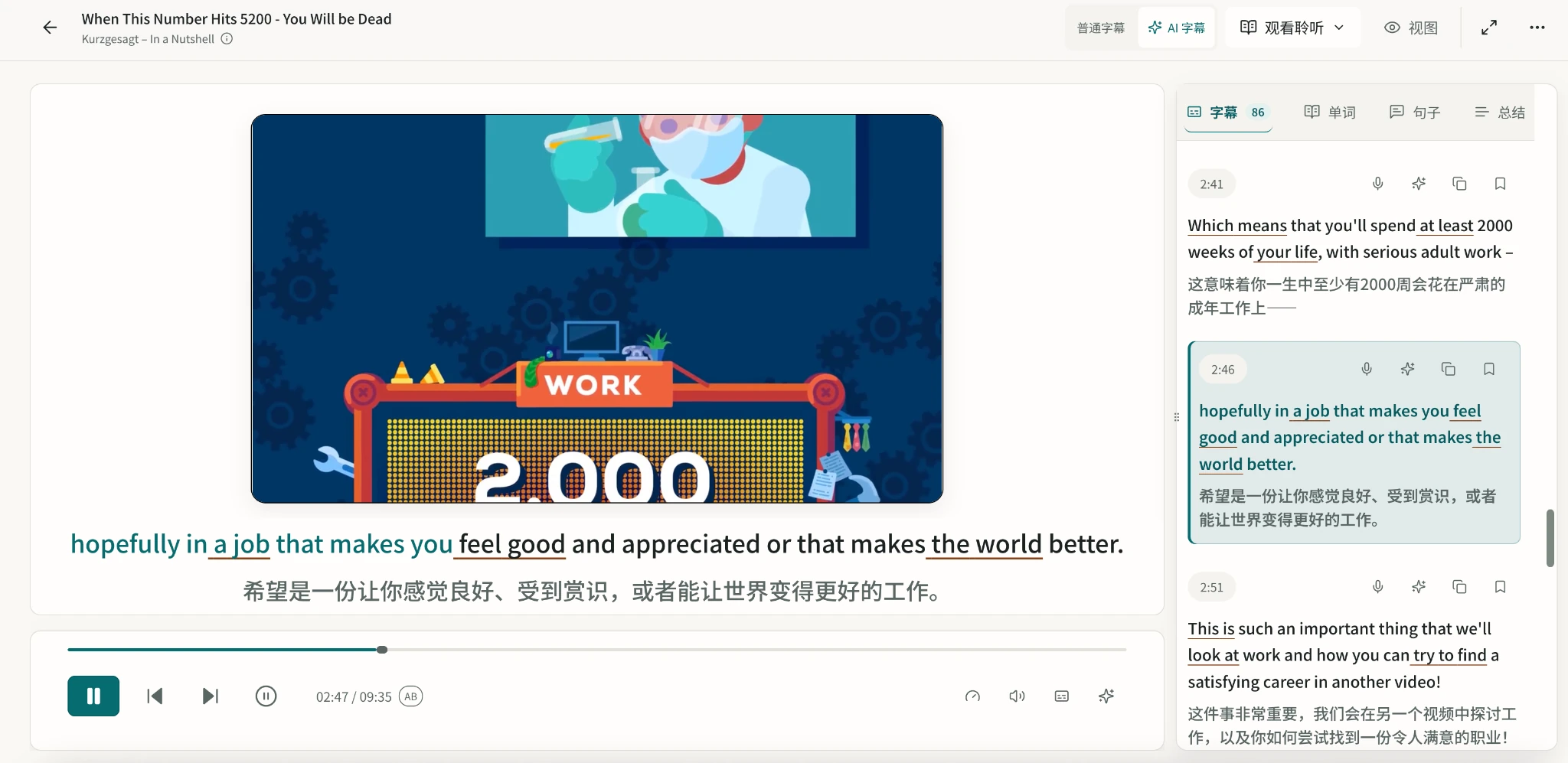
Before shadowing, make sure you understand the short passage you have chosen. Then listen for its sound: stressed and reduced words, connected speech, and pauses.
For shadowing, keep the audio playing and repeat what you hear with a short delay. If you cannot keep up yet, listen to a sentence, pause, and imitate it. Once it feels familiar, try following the recording as it plays.
LearnBit's word-by-word highlighting helps you locate an expression as you hear it. Use automatic sentence-end pauses, single-sentence loops, or A-B looping to revisit a difficult part. Slow the audio if needed, then return to normal speed once you can hear it clearly. After shadowing, record a sentence separately and compare it with the original for stress, pauses, and fluency.
For the water-cycle example, listen to a sentence about condensation and check water vapor and tiny droplets. Try saying it along with the recording. Once it feels manageable, add the sentences before and after it.

In a study of Japanese university students, Hamada observed improvements in recognizing prominent stress and words in speech after a month of shadowing training.[6] Give a practice session one focus, such as a reduced word or the stress in a sentence.
After practicing the short passage, return to the video and follow what the speaker is saying. For your next choice, start with another question you want answered, then find an explanation you can follow.
References and further reading
Learner discussions: Children's shows help, but become boring; Are cartoons really easier?. Personal experiences illustrating common material-selection problems.
Krashen, S. D. (1982). Principles and Practice in Second Language Acquisition, pp. 20–22.
van Zeeland, H., & Schmitt, N. (2013). Lexical Coverage in L1 and L2 Listening Comprehension. Applied Linguistics, 34(4), 457–479.
Durbahn, M., Rodgers, M., Macis, M., & Peters, E. (2024). Lexical coverage in L1 and L2 viewing comprehension. Studies in Second Language Acquisition, 46(4), 1045–1068.
Leeser, M. J. (2004). The Effects of Topic Familiarity, Mode, and Pausing on Second Language Learners' Comprehension and Focus on Form. Studies in Second Language Acquisition, 26(4), 587–615.
Hamada, Y. (2022; first published online in 2020). Developing a New Shadowing Procedure for Japanese EFL Learners. RELC Journal, 53(3), 490–504.